Net profit
The full calculation from gross sales to net profit, and how order profit becomes store profit.
On this page
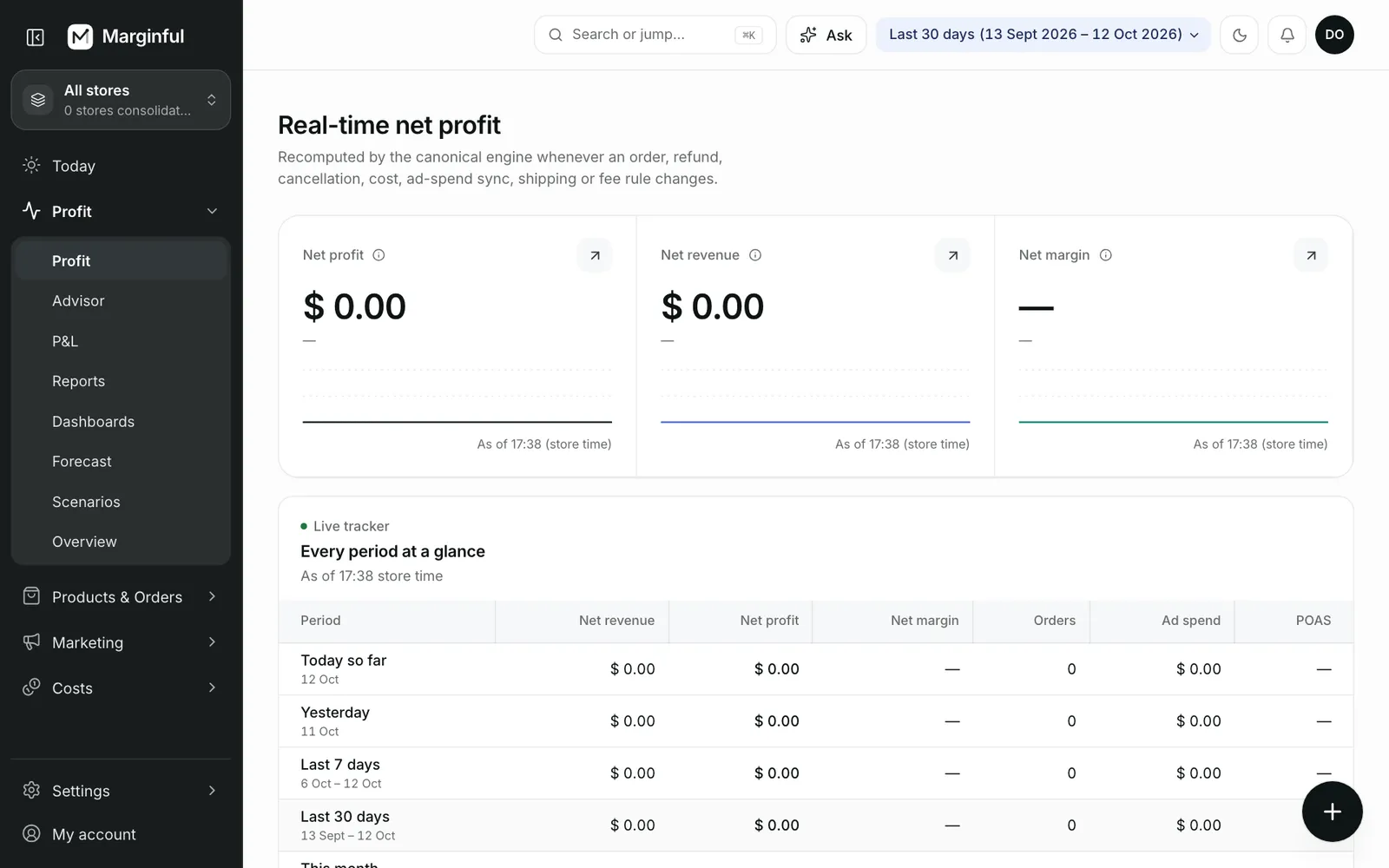
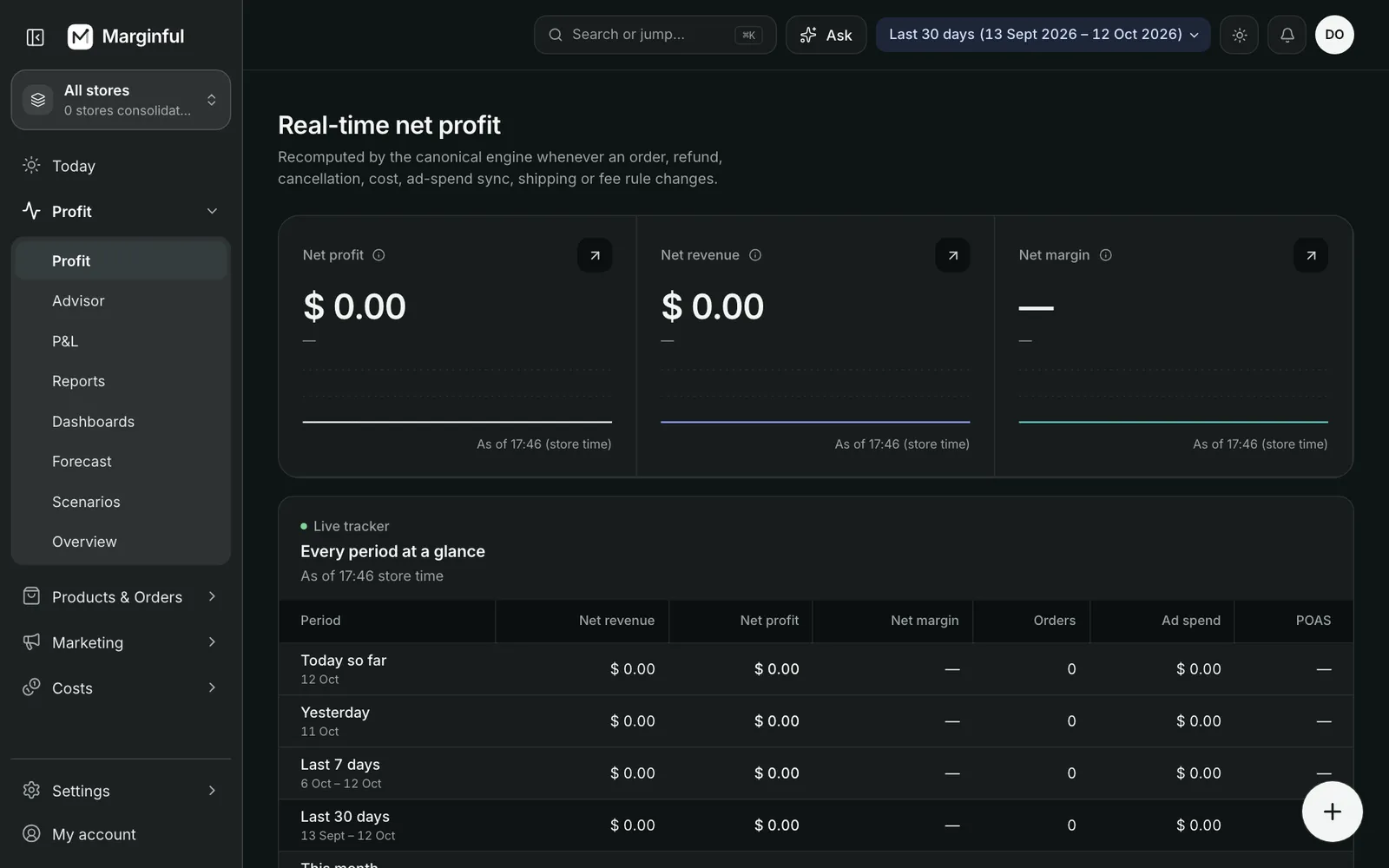
Net profit is what you keep after every cost Marginful knows about. It is built in two stages: first per order, then for the whole period.
Stage 1: each order
Gross sales
− Discounts
− Refunds
= Net sales
Shipping charged (net of shipping refunds) + Tips
− Taxes (when "Subtract collected tax from revenue" is on)
= Net revenue
− COGS (net of restocked returns)
= Gross profit
− Shipping − Handling − Payment fees − Fulfillment − Packaging − Return costs − Chargebacks − Order-level custom costs
= Order contribution (before advertising)
Stage 2: the period
Some costs belong to a day, not to an order. Marginful applies them to the period:
Σ Order contribution
− Ad spend
− Marketing costs, variable period custom costs, warehouse storage, gateway fees not tied to an order
= Contribution profit
− Fixed custom costs (not marketing)
− Operating expenses
= Net profit
Example
One month for a store, in USD:
| Line | Amount |
|---|---|
| Gross sales | $11,000 |
| − Discounts | $600 |
| − Refunds | $400 |
| + Shipping charged | $500 |
| − Taxes | $500 |
| Net revenue | $10,000 |
| − COGS | $4,000 |
| Gross profit | $6,000 |
| − Shipping, fees and other variable costs | $1,500 |
| − Ad spend | $2,000 |
| Contribution profit | $2,500 |
| − Operating expenses | $1,200 |
| Net profit | $1,300 |
Net margin is $1,300 ÷ $10,000 = 13.0%.
Order profit and store profit
The Orders page shows order profit: each order's contribution minus its share of that day's ad spend. Ad spend is shared between a day's orders by revenue (the default), by order count, or by attributed conversions. Change this in Settings → Store & tax → Allocation & inventory.
Store net profit is lower than the sum of order profit, by exactly these amounts:
- Ad spend on days with no orders.
- Agency and other marketing period costs.
- Other variable period costs (period custom costs, warehouse storage, gateway fees not tied to an order).
- Fixed costs.
- Operating expenses.
The Profit page shows this bridge, so the two figures always reconcile.
Orders that do not count
- Test orders.
- Orders that were cancelled, never fulfilled and fully refunded.
These orders are kept but show zero in every figure.
Missing product costs overstate profit
A product without a cost adds nothing to COGS. Until you add the cost, gross profit and net profit are too high. Marginful flags these orders and raises a Missing COGS alert. See Product costs.
Was this page helpful?